
Publix Field at Joker Marchant Stadium at TigerTown USA in Lakeland, Florida.*

The Hooters restaurant located at 3400 U.S. 98 North in Lakeland, Florida.*
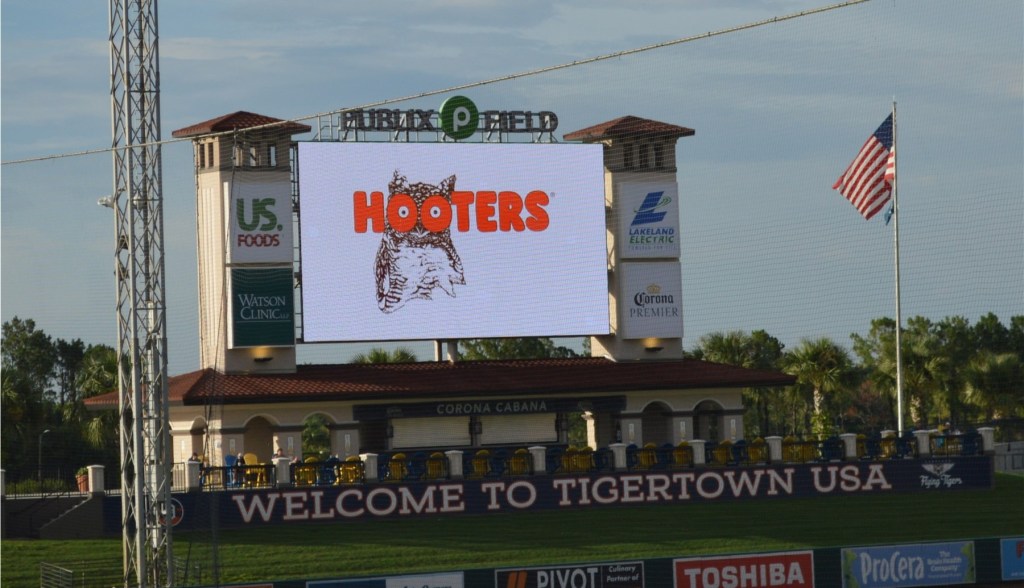
A Hooters promotional graphic on the Joker Marchant Stadium scoreboard.*
Lakeland, Florida, USA | 8 July 2023 (Image added 23 March 2025). On autumn and winter nights being around TigerTown is almost like ‘Living in a Ghost Town’, to borrow an analogous title from the Rolling Stones’ 2020 hit song – which was playing inside the nearest Hooters restaurant while digital photographs were being captured for this article and tasty boneless chicken wings consumed.

Above: Kenna, a consummate ‘Hooters Girl’, nursing student and aspiring flight nurse.

Above: ‘Hey, ya’ll!’: A ‘Hooters Host’.*
According to the Vintage Baseball Association, by 1866 the sport of baseball had overtaken ‘cricket’ as Americans’ favourite pastime, so much so that by that year there were hundreds of baseball clubs located on the east coast and in the Midwest. Although, as in the case of cricket, the English may have created the essentials of baseball, the neighbours north of the border in Canada significantly contributed toward the game’s modernisation. According to David Giddens’ article ‘How Canada invented ‘American’ football, baseball, basketball and hockey’, the first officially recorded baseball game in North America was played in Beachville, Ontario, Canada, on 4 June 1838. Additionally, in Canada, a Canadian player by the name of Arthur Albert Irwin essentially invented the baseball glove (‘mitt’), bases, and scoreboards.

Exceptional ‘Hooters Girl’ Cai.*
As noted on the Florida Grapefruit League website, the Detroit Tigers’ relationship with the City of Lakeland dates to 1934 and is the longest-standing relationship between a major league team and a contemporary Spring Training hosting community. For years the Detroit Tigers trained and played exhibition games at Henley Field, which now serves as the home of Florida Southern University’s team.
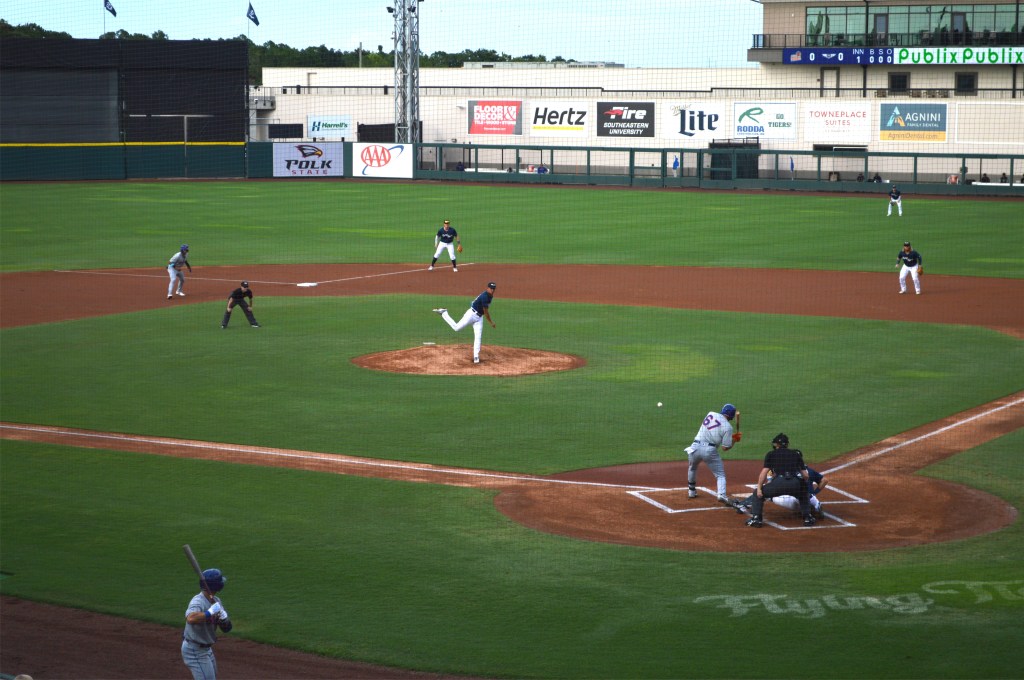
Lakeland Flying Tigers in the field playing the St. Lucie Mets on 8th July 2023.*
The year 1953 saw the beginning of construction on the TigerTown spring training facility, which was constructed over part of the former Lodwick School of Aeronautics’ grounds while the city continued using the airfield.
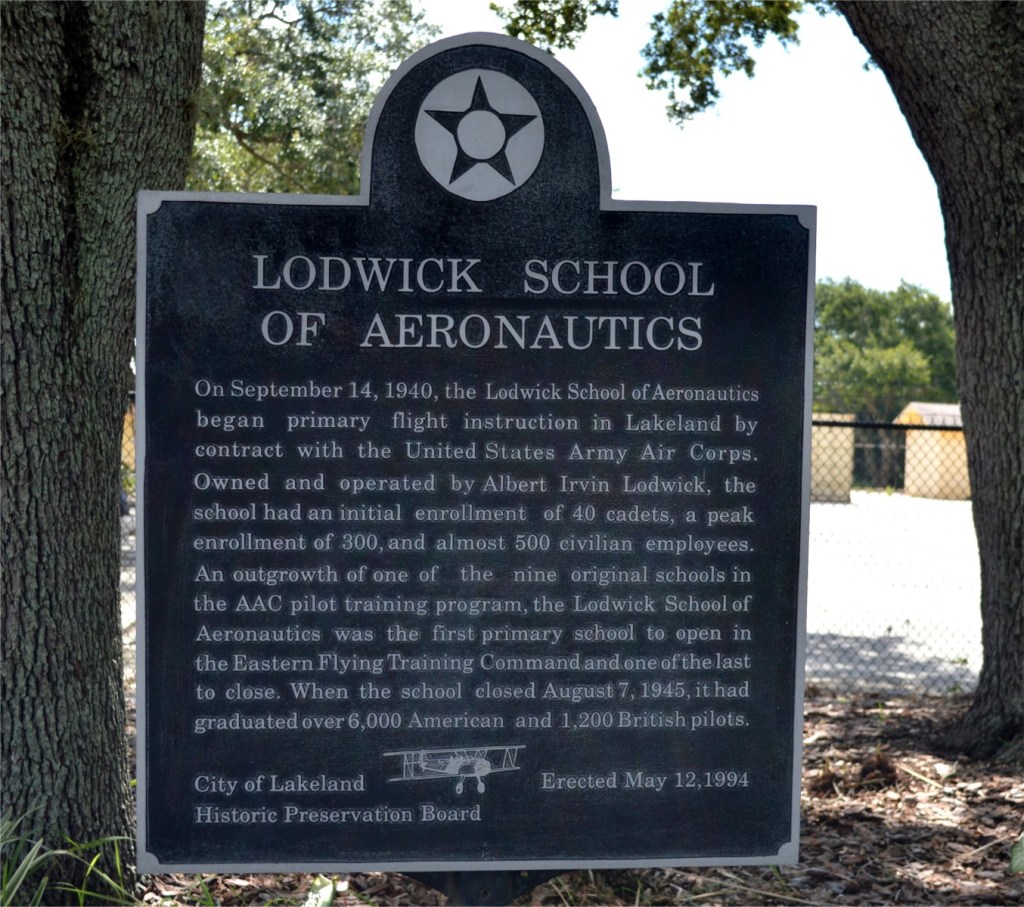
Lodwick historical marker at TigerTown USA.*
Time inevitably marched forward and additional Lodwick acreage was incorporated for the TigerTown centre. By the end of 1958 the complex encompassed much of the remains of the aeronautical institution.
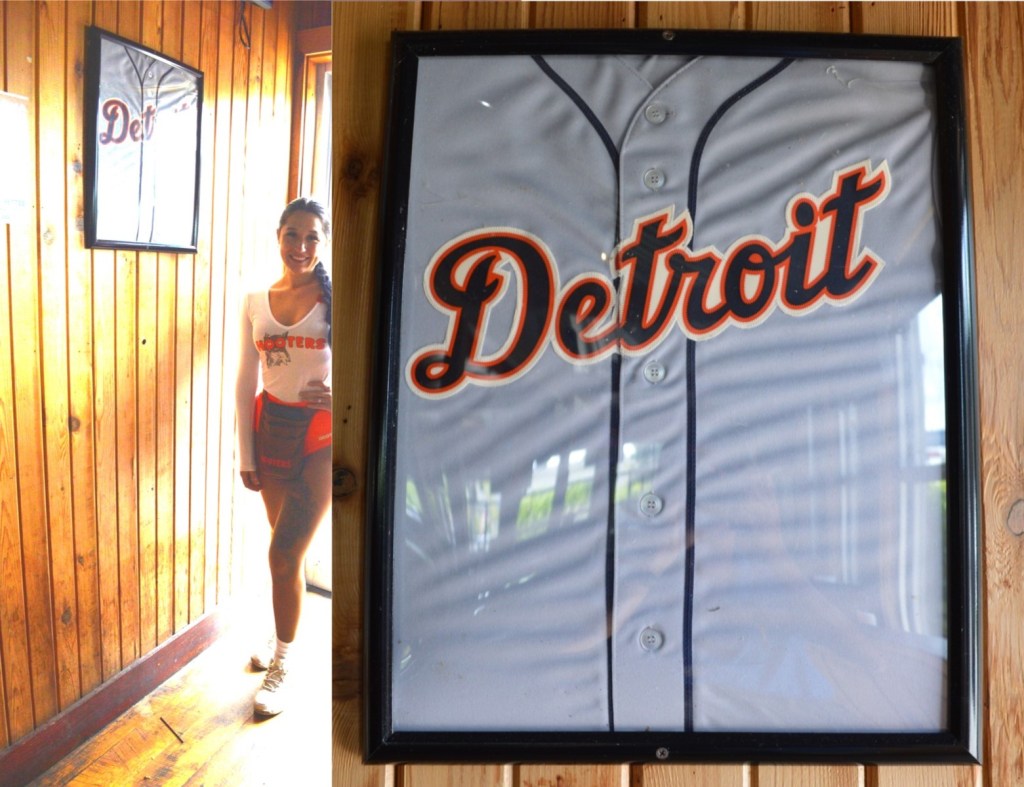
‘Hooters Girl’ Shanna poses with a framed Detroit Tigers uniform jersey.*

Lon Cooper at his home in 2013.*
Instructors, one of whom was the late Lon Cooper, at Lodwick’s schools in Avon Park and Lakeland trained thousands of American aviators for the U.S. Army Air Forces between 1940 and 1945 and British pilots in Lakeland for the Royal Air Force until October of 1942.

An image from a Lodwick wartime brochure.*
Notably, the Lakeland Public Library archives contain records that indicate a number of the Royal Air Force graduates of the Lodwick School of Aeronautics (which operated under the designations of United States Army Air Forces 2160th Army Air Forces Base Unit and 61st Flying Training Detachment) subsequently died while on service with Royal Air Force Bomber Command. As Bomber Command Museum of Canada can confirm, numbers of the American aircrew undoubtedly also perished in theatres around the world.
A new name and colours were adopted in 2006 to salute the defunct and adjacent Second World War era Lakeland School of Aeronautics (later known as the Lodwick School of Aeronautics. Later, in 2007, the Lakeland-based baseball club became the Flying Tigers.

The orange-tinted Curtiss P-40 logo of TigerTown USA.*
One official Lakeland Flying Tigers winged logo features an orange-tinted Second World War-era Curtiss P-40 fighter plane, which were designated as ‘Tomahawks’ and ‘Kittyhawks’ by the Royal Air Force and British Commonwealth air forces.
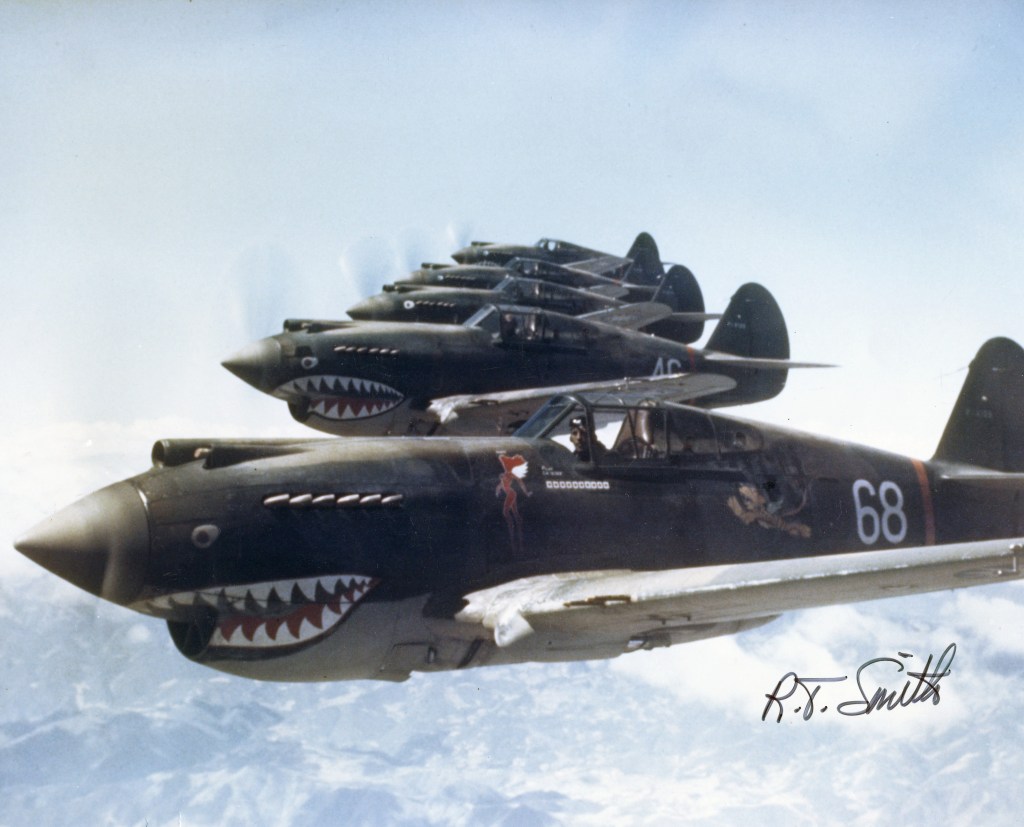
AVG Third Squadron (‘Hells Angels’) aloft over China during 1942.
Public Domain image via Wikipedia.
The label ‘Flying Tigers’ refers to the famous American Volunteer Group or ‘AVG’ (officially designated ‘the 1st American Volunteer Group’). AVG pilots piloted various models of Curtiss P-40 fighter planes adorned with shark mouths, the China-based units having borrowed the engine cowling livery from No. 112 Squadron of the Royal Air Force.

Curtiss Kittyhawks of No. 112 Squadron, RAF, in Tunisia – 1943.
Public Domain image via Wikipedia.
The ‘Yanks’ flew in combat against Japanese army and Imperial Japanese Navy aviators. On 4th July 1942, the AVG officially ceased operations and the Americans and their equipment were integrated into the United States Army Air Forces’ (USAAF) 23rd Fighter Group and USAAF aircraft markings were affixed over the Chinese Air Force symbols. Afterward, the 23rd continued to employ the shark mouth markings on its P-40s noses. Eventually, the 23rd became a component of the USAAF’s Fourteenth Air Force.
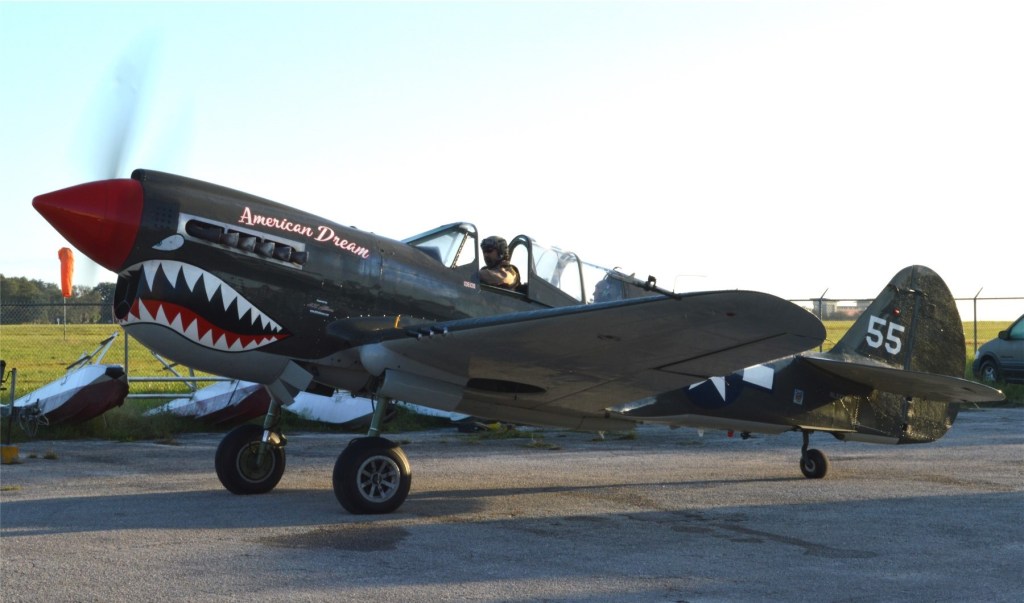
Curtiss P-40 departing the famous 60-year-old Jack Brown’s Seaplane Base in 2020.*
Extant and airworthy P-40s are rare, but a few can on occasion be spotted transiting the Lakeland area. In fact, one is based at Fantasy of Flight in Polk City. Furthermore, an example of the flying machine sometimes appears at the annual SUN ‘n FUN Aerospace Expo, which takes place at Lakeland Linder International Airport each April, or elsewhere around area.
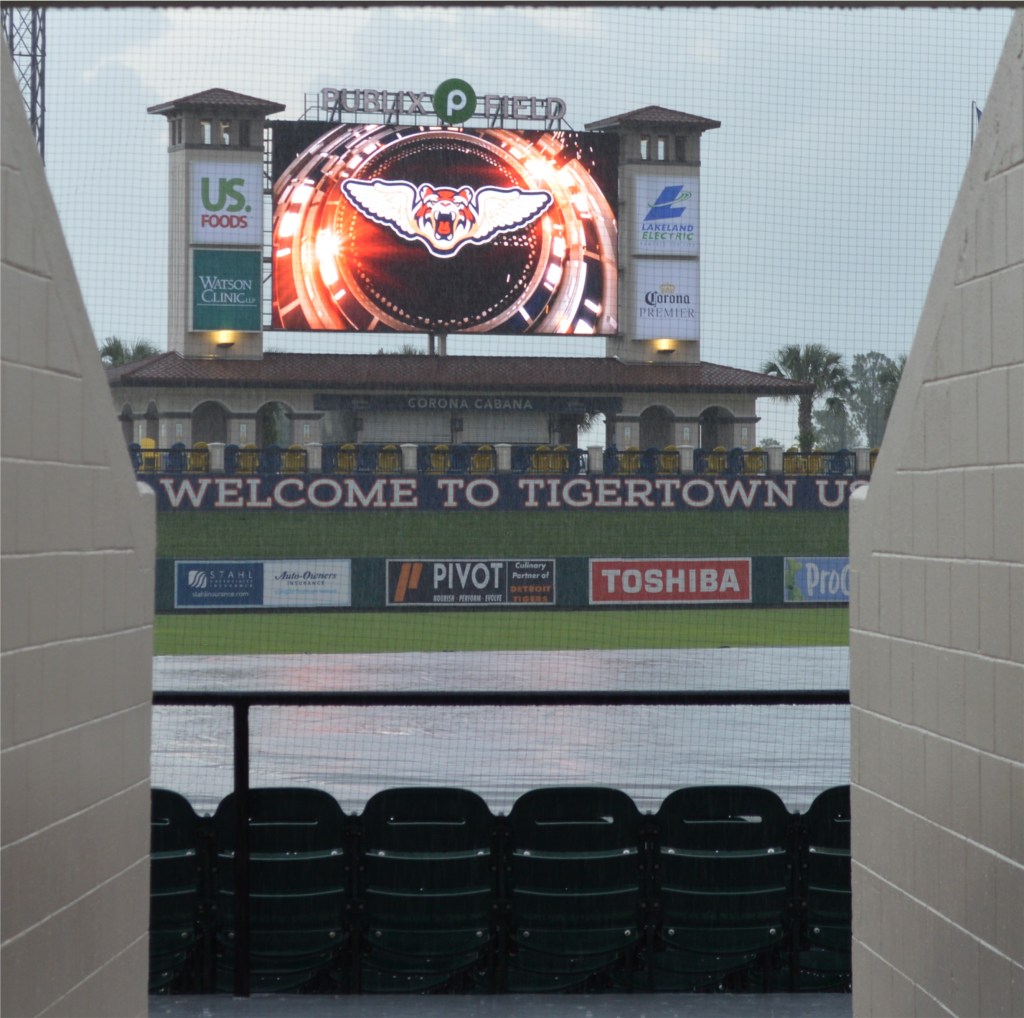
A view of the display screen from an entrance tunnel.
Around Publix Field at Joker Marchant Stadium symbols of the Detroit Tigers’ storied legacy are plentiful.
The ballpark is truly a field of dreams, to borrow the title of the 1989 film Field of Dreams (which was based upon a 1982 novel titled Shoeless Joe) by Canadian writer William Patrick Kinsella, OC, OBC.
Attendees can almost sense the presence of Detroit Tiger greats such as Ty Cobb. Cobb is a legendary Detroit Tigers player. Simply put, an icon. Sportswriter and longtime friend of Ty Cobb H.G. Salsinger wrote in a North American Newspaper Alliance feature (Our Ty: Ty Cobb’s Life Story – published in 1924) that ‘Ty Cobb revolutionized and remade the sport of a nation’. He also penned,’There has been but one Cobb. There is likely never to be another. In him were strangely combined all those qualities that were needed to make the perfect competitor, a man with playing faults but with the most highly developed competitive spirit and the finest developed brain that the national pastime of the United States has produced’.
Daniel Okrent and Harris Lewine, editors of The Ultimate baseball Book, include a few period statements about Ty Cobb. Sportswriter and playwright Bozeman Bolger wrote: ‘He was possessed by the Furies’. Branch Rickey, an Ohioan and former professional player, manager of the Brooklyn Dodgers and other teams, institutor of the player development or ‘farm’ system, and the man responsible for bringing Jackie Robinson into the racially segregated Major Leagues after World War 2, stated the following about Ty Cobb: ‘Cobb lived off the field as though he wished to live forever. He lived on the field as though it was his last day’. Additionally, Connie Mack, a former catcher and owner of the Philadelphia Athletics, once told his team, in reference to the quick-tempered and controversial Ty Cobb, the following: ‘Let him sleep, if he will. If you get him riled up, he will annihilate us’. Furthermore, author and baseball expert Robert W. Creamer, within his 1974 work Babe, bluntly states, while citing Ty Cobb’s greatness, that Cobb was ‘a psychotic’.
A former New York Yankees competitor by the name of George Herman ‘Babe’ Ruth, who, as Bill Jenkinson states within his book The Year Babe Ruth Hit 104 Home Runs, had by 1919, ‘replaced Ty Cobb as baseball’s single biggest megastar’. Nevertheless, Cobb continued to play well and compete with fierce determination. Ruth may have become the greatest all-around player of the era, but Glen Sparks makes the point in his book Pee Wee Reese: The Life of a Brooklyn Dodger, that during the initial Baseball Hall of Fame induction ceremony, which took place on 12 June 1939, the Tigers’ Ty Cobb garnered 98.2% of the votes whereas Babe Ruth registered 95.1%. Also noteworthy is that sportswriter William R. Cobb (no relation to Ty Cobb), within the Editor’s Notes (page xi) of Ty Cobb: Two Biographies, records that the 1950 sportswriters poll to determine baseball’s greatest player of all time selected Babe Ruth with ‘twice as many votes as second-place Ty Cobb’ — but, he adds, ‘102 major league players, managers and baseball executives polled by The Sporting News in 1942 . . . gave the accolade to Ty Cobb by a margin of six to one over third place Ruth’. Whose opinions should carry the most weight?
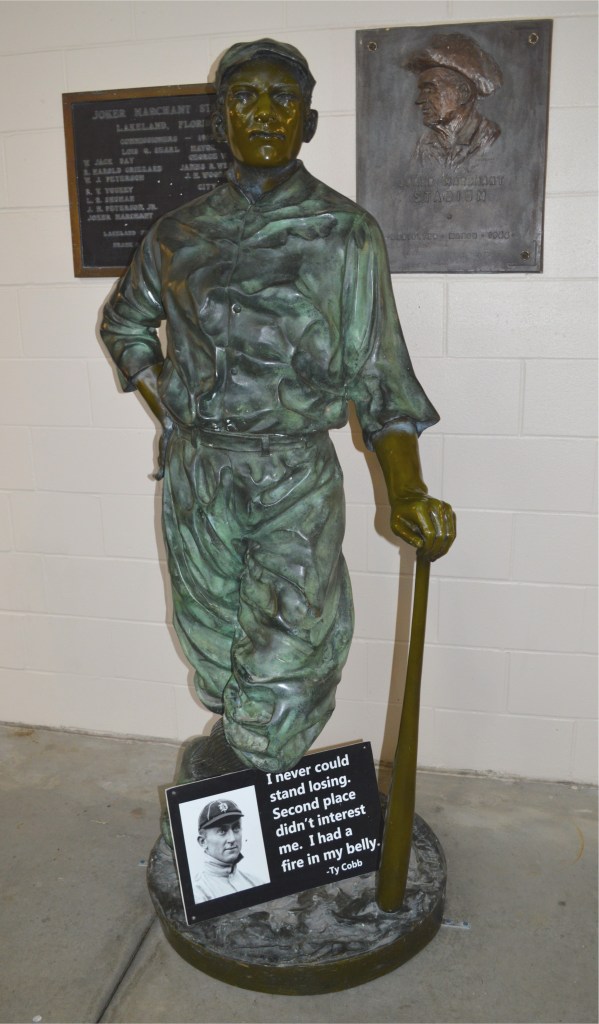
Ty Cobb statue in the stadium entryway.*

Babe Ruth and Ty Cobb in 1928.
Public Domain image via Wikipedia.
Florida has long had a large population of senior citizens, and for them viewing a Detroit Tigers spring training or Lakeland Flying Tigers game can engender memories of their more carefree youth. For the ‘Single A’ athletes, performances in front of managers and farm system scouts represent testaments to their visions of moving up toward the ultimate goal of playing ball in the ‘Big Leagues’. Today’s reality is tomorrow’s history, which continues to be made on Publix Field at Joker Marchant Stadium.
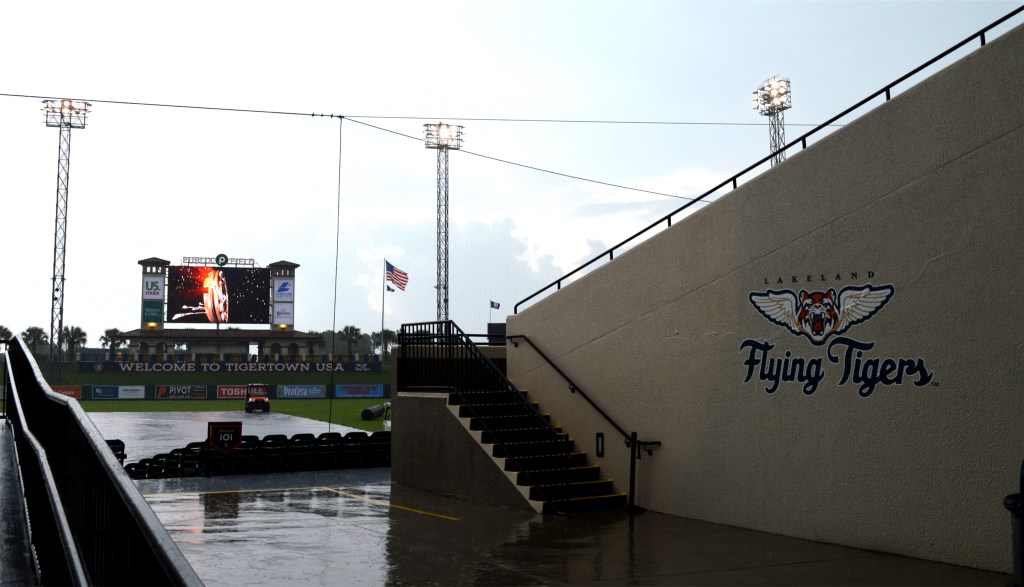
A view of the electronic scoreboard screen before the game.*
It is recommended that one attend a Lakeland Flying Tigers home game for an enjoyable respite from the daily grind of contemporary life. Tickets may be purchased online or in person at the Box Office; the telephone number is (863) 686-8075.
*Unless otherwise noted, all images contained in this article were created by John T. Stemple for Military Aviation Chronicles.
__________
The author (John T. Stemple) and Military Aviation Chronicles thank the Lakeland Flying Tigers and Hooters for their cooperation during the preparation of this article. John is a member of the Vintage Base Ball Association and he attributes his lifelong love of baseball to his paternal grandfather, George Benjamin Stemple, who was employed by the Kuhns Brothers Company in Dayton, Ohio. (The foundry manufactured cast iron pipe fittings.) George played baseball for the amateur factory team, which was named the ‘K-Fittings’, circa 1928 to the early 1930s. The semiprofessional Dayton ‘Aviators’ of the Class B Central League played at North Side Ballpark. George was scouted and subsequently offered a position as a player with the Aviators. However, he declined the offer due to considerations relating to his familial responsibilities.
The author also salutes retired former Detroit Tiger Frederick John Scherman Jr., who was born in Dayton, Ohio, and also eventually became a licensed pilot. Fred, was a 1.8542 metre/6-foot-1 inch) southpaw (a left-handed pitcher in baseball vernacular). He hails from Dayton, Ohio, and still resides in that metropolitan area.

Fred Scherman as a young Detroit Tiger circa 1969. Original in author’s collection.
While a high school player he developed an effective screwball to augment other pitches. In 1962, after graduating from high school, Scherman played baseball for the Dayton Class A Wiedemann-Budweiser amateur team. Subsequently, he attended the Ohio State University, but left college and signed with the Minnesota Twins of the American League in 1963; he played for the Florida State League Single-A Orlando Twins during the 1964 season.
During the 1964 season, Scherman’s hurling skills beat the Lakeland Tigers four times. As a result, the Lakeland manager recommended that the Lakeland Tiger’s parent Detroit Tigers, also in the American League, club draft him. The Detroit Tigers did indeed, in December 1964, obtain Scherman from the Twins organization. Scherman was soon assigned to the Rocky Mount Leafs, but was hit by a pitch during a game and suffered tendon damage in the elbow of his pitching arm.
Scherman successfully rehabilitated and spent a total of four seasons in the Detroit Tigers’ farm system, which consisted of periods of play with the Rocky Mount Leafs during 1965-1966, Montgomery Rebels from 1966-1967, and Toledo Mud Hens in the 1968 season.
Fred was initially a starting pitcher circa 1967-1968, at which point he transitioned into a relief pitching role. Scherman made his Detroit Tiger and major league debut at the age of 24 years, when on April 26, 1969, he took the mound during a regular season matchup. As a pitcher, Scherman relied on his fastball, which he described as a sinking, moving fast pitch, and his success came after he gained full control of it. Fred mixed in a slider and occasionally a curveball or ever more rarely a changeup offering. Scherman recorded his first major league win against the Oakland Athletics on August 28, 1969.
In 1971, Fred Scherman emerged as the closing pitcher under the team’s new manager Billy Martin. Martin said, in a June 10, 1971, Dayton Daily News Si Burick column titled “Tireless Scherman Is Suddenly Tigers’ Top Emergency Pitcher” said the following: “He’s our No. 1 man in the extremely difficult situations.” During the 1971 season, Fred set a Detroit Tigers record by making 69 pitching appearances, which was the second most in the American League, and compiled an 11-6 record with a 2.71 ERA, with 20 saves, and attained a total of 40 complete games. Scherman won the “King Tiger” award from Detroit fans in both 1971 and 1972.
In total, Fred Scherman spent five years (1971-1973) with the Detroit Tigers. In December 1973, Fred was traded to the Houston Astros, a club affiliated with the National League at the time, and he played two seasons (1974 and 1975) with the American League club. The National League’s Montréal Expos purchased Fred in June 1975, and he pitched for them in 1975 and 1976. Scherman pitched satisfactorily during his last Major League appearance, on July 6, 1976, although the Montréal Expos lost that day to the Cincinnati Reds.
Fred Scherman attempted a comeback in 1977 via the Pittsburgh Pirates’ (National League) system, but when no other team claimed him, the Pirates sent him down to their Columbus Clippers farm club in central Ohio, which was an International League member team.
In 1978, Scherman relocated to Japan on the expectation of a playing contract with the Hiroshima Toyo Carp (Central League) of Nippon Professional Baseball. After arriving, Fred learned that the Carp possessed an excess of American players, and he was sent to a minor league club as a player-coach. Fred Scherman’s career was then essentially at an end.
Suggested Viewings
YouTube: The Rolling Stones – Living In A Ghost Town: The official video for Living In a Ghost Town by The Rolling Stones
Sources and Suggested Readings
Babe Ruth
https://en.wikipedia.org/wiki/Babe_Ruth
Baseball
https://en.wikipedia.org/wiki/Baseball
Baseball’s history in Dayton: From the ‘Gem Citys’ of 1884 to the Dragons of today
Benjamin Bolger
https://en.wikipedia.org/wiki/Benjamin_Bolger
Bill Jenkinson, The Year Babe Ruth Hit 104 Home Runs. New York: Carroll & Graf Publishers/Avalon Publishing Group, 2007, 35.
Branch Rickey
https://en.wikipedia.org/wiki/Branch_Rickey
British ‘East Florida’
https://en.wikipedia.org/wiki/East_Florida
Charlie Gehringer
https://en.wikipedia.org/wiki/Charlie_Gehringer
Cincinnati Reds
https://en.wikipedia.org/wiki/Cincinnati_Reds
Cincinnati Reds vs Montreal Expos Box Score: July 6, 1976
https://www.baseball-reference.com/boxes/MON/MON197607060.shtml
Connie Mack
https://en.wikipedia.org/wiki/Connie_Mack
Cricket
https://en.wikipedia.org/wiki/Cricket
Daniel Okrent and Harris Lewine, editors. The Ultimate baseball Book. Boston: Houghton Mifflin Company, 1979, pages 62 and 82.
Dayton Aviators
https://en.wikipedia.org/wiki/Dayton_Aviators#Year-by-year_records
Dayton Aviators
https://www.baseball-reference.com/bullpen/Dayton_Aviators
Dayton Aviators Franchise History (1928-1930)
https://www.statscrew.com/minorbaseball/t-da11191
Federick John Scherman Jr
https://en.wikipedia.org/wiki/Fred_Scherman
Frank Robinson joins the 500 home run club
https://baseballhall.org/discover/inside-pitch/frank-robinson-hits-500th-home-run
Fred Scherman
https://www.baseball-reference.com/bullpen/Fred_Scherman
Fred Scherman
https://www.baseball-reference.com/players/s/scherfr01.shtml
Fred Scherman Baseball Stats
https://www.baseball-almanac.com/players/player.php?p=scherfr01
Fred Scherman Minor League Statistics
https://www.baseball-reference.com/register/player.fcgi?id=scherm001fre
Glen Sparks. Pee Wee Reese: The Life of a Brooklyn Dodger. Jefferson, NC: McFarland & Company, Inc. Publishers, 2022, page 41.
H.G. Salsinger, editor. Ty Cobb: Two Biographies. Our Ty: Ty Cobb’s Life Story (1924) and Which was Greatest: Ty Cobb or Babe Ruth? (1951). Jefferson, North Carolina: McFarland & Company, Inc., Publishers, 2012.
Hiroshima Toyo Carp
https://en.wikipedia.org/wiki/Hiroshima_Toyo_Carp
Houston Astros
https://en.wikipedia.org/wiki/Houston_Astros
How did Tigers’ spring site get its name? A visionary named Joker and a home-grown supermarket
Jack Brown’s Seaplane Base
Jackie Robinson
https://en.wikipedia.org/wiki/Jackie_Robinson
Joker Marchant Stadium
https://en.wikipedia.org/wiki/Joker_Marchant_Stadium
Lakeland Flying Tigers
https://www.milb.com/lakeland/
Lakeland Flying Tigers
https://en.wikipedia.org/wiki/Lakeland_Flying_Tigers
Lakeland Linder International Airport
https://en.wikipedia.org/wiki/Lakeland_Linder_International_Airport
Lakeland Public Library – Special Collections
Lawrence S. Ritter. The Glory of Their Times: The Story of the Early Days of Baseball Told by the Men who Played It. New York: Harper Perennial, 2010, page xvi.
Living in a Ghost Town
https://en.wikipedia.org/wiki/Living_in_a_Ghost_Town
Lodwick Photo Collection – Lakeland Public Library
https://lakelandpubliclibrary.contentdm.oclc.org/digital/collection/p15809coll8
Lodwick School of Aeronautics Airplanes on the Flight Line
https://lakelandpubliclibrary.contentdm.oclc.org/digital/collection/p15809coll8/id/41/
Lodwick School of Aeronautics Cadet Publications – Lakeland Public Library
https://lakelandpubliclibrary.contentdm.oclc.org/digital/collection/p15809coll53
Lon Cooper recalls WWII Civilian Pilot Training Programme
Negro National League (1920–1931)
https://en.wikipedia.org/wiki/Negro_National_League_(1920%E2%80%931931)
Minnesota Twins
https://en.wikipedia.org/wiki/Minnesota_Twins
Montreal Expos
https://en.wikipedia.org/wiki/Montreal_Expos
No. 112 Squadron, RAF
https://en.wikipedia.org/wiki/No._112_Squadron_RAF
RAF Bomber Command
https://en.wikipedia.org/wiki/RAF_Bomber_Command
Robert W. Creamer, Babe, New York: Simon and Schuster, 1974, page 18.
Rounders
https://en.wikipedia.org/wiki/Rounders
Shoeless Joe (novel)
https://en.wikipedia.org/wiki/Shoeless_Joe_(novel)
Si Burick (June 10, 1971). “Tireless Scherman Is Suddenly Tigers’ Top Emergency Pitcher”. Dayton Daily News. p. 10 – via Newspapers.com
https://www.newspapers.com/article/dayton-daily-news-tireless-scherman-is-s/33964665
The Lodwick School of Aeronautics: A photo Exhibit
Stoolball
https://en.wikipedia.org/wiki/Stoolball
The Official Site of the Lakeland Flying Tigers
https://www.milb.com/lakeland/
TigerTown: Lodwick School of Aeronautics
https://laltoday.6amcity.com/tigertown-lodwick-school-aeronautics
TigerTown: Why the Detroit Tigers are in Lakeland
https://laltoday.6amcity.com/tigertown-detroit-tigers-lakeland
Ty Cobb
https://en.wikipedia.org/wiki/Ty_Cobb
United States Army Air Forces Contract Flying School Airfields
https://en.wikipedia.org/wiki/United_States_Army_Air_Forces_Contract_Flying_School_Airfields
W. P. Kinsella
https://en.wikipedia.org/wiki/W._P._Kinsella
What is Vintage Base Ball?

