
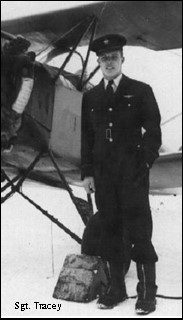
Above: Ed Tracey in Royal Canadian Air Force (RCAF) uniform circa February 1942.
(Photo: Tim Tracey)
____________________________________________
Ed Tracey: RCAF-American, Second World War Flight Instructor and USAAF Fighter Pilot
Second Edition: (Content Updated 18 September 2024)
by
John T. Stemple and Tim Tracey (Edward ‘Ed’ Tracey’s son)
[All Rights Reserved]
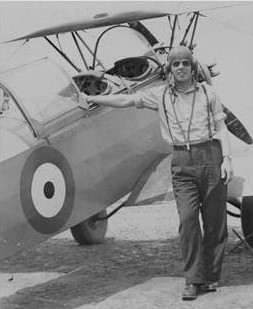
Above: Ed Tracey posing with an RCAF Fleet ‘Finch’ during training in the summer of 1941.
(Photo: Tim Tracey)
Originally Posted 31 March 2016 (Second Edition – 18 September 2024) | Despite the passage of more than seven decades, historians are still learning of overlooked heroes from the Second World War as the clouds of time briefly part to reveal sagas that were previously unknown. A minority of these stories feature quiet, unassuming individuals who have provided great service in the armed defence of democracy. Edward ‘Ed’ Tracey is one notable example. He was supporting the British Empire (and in fact America) as a RCAF flying training instructor before the United States officially entered the great conflagration and later fought for his own homeland.
According to Karl Kjarsgaard of Bomber Command Museum of Canada (BCMC), in excess of 8,000 Americans joined the Royal Canadian Air Force (RCAF) during the early years of World War II. Edward Tracey, who hailed from Cortland, Ohio, was one of these valiant men. Cortland is a city located near Youngstown that lies within Trumbull County. The family’s residential postal service delivery address at the time was ‘R.F.D. (Rural Free Delivery) #3’. That designation would serve as a personal moniker for fighter aeroplanes assigned to him years hence in the Mediterranean Theatre of Operations.

(Graphic: Tim Tracey)
Europe was at war before the end of 1939. England and her British Commonwealth of Nations, which of course included the Dominion of Canada, were warring with Nazi Germany. About this time Ed acted on his attraction to aviation and commenced flying lessons under the instruction of Ernie C. Hall at Hall Airport in Howland, Ohio. Ernie Hall was an accomplished aviator and acquaintance of the famous Wright brothers (Orville Wright and Wilbur Wright) of Dayton, Ohio. The ‘Daytonians’ are credited with designing the first practical, powered, heavier-than-air flying machine and making the initial successful flights of an ‘aeroplane’ in December 1903 on a beach at Kill Devil Hills, North Carolina.

Above: Ed Tracey poses with a Piper J-4 ‘Cub Coupe’ at Hall Airport.
(Photo: Tim Tracey)

Above: Hall Airport as seen from the air by Ed Tracey circa 1939-1940.
(Photo: Ed Tracey via Tim Tracey)
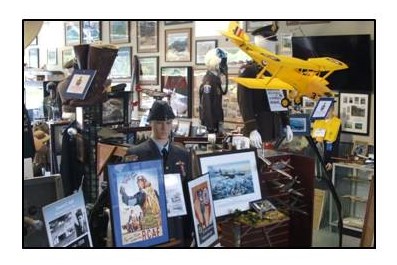
Above: An internal view of the Ernie Hall Aviation Museum in Warren, Ohio.
(Photo: Tim Tracey)
A leading proponent of recruiting Americans for RCAF service was famous WWI Canadian aviator Air Marshall W. A. ‘Billy’ Bishop. Writer Fred Gaffen states (page 47) in Cross-Border Warriors: Canadians in American Forces, Americans in Canadian Forces From the Civil War to the Gulf that Bishop remembered ‘the contribution of the Americans who had flown with British squadrons in the First World War . . .’
Early in the Second World War the RCAF needed large numbers of pilots because the creation of the British Commonwealth Air Training Plan (BCATP) effectively made Canada a centre for aircrew training. On 7 June 1940, Canada removed the requirement for foreign volunteers to pledge allegiance to the British monarch; they now had only to obey military orders. The gates were then wide open, on the Canadian side of the border at least, to those desiring to serve Canada and England (the three nations’ mother country).

Above: A few of the American volunteers deserving of recognition via H.R. 1372.
(Graphic: Tim Tracey)
With the goal of recruiting aircrew for the BCATP, the Clayton Knight Committee maintained a recruiting center in Cleveland, Ohio, and elsewhere. Representatives actively sought American pilot candidates, pilots and other qualified individuals for the RCAF, Royal Air Force (RAF) and RAF Ferry Command. Now a licensed pilot, in May 1941 Ed Tracey made the relatively short journey from Ohio, which borders Canada, to a Royal Canadian Air Force enlistment reception centre. Two other famous pilots from the Buckeye State, namely Don Gentile and Donald Blakeslee, also made excursions to Canada and ended up in RCAF and RAF uniforms. Furthermore, other Ohioans and thousands of people from the other forty-seven contiguous states (and additionally the then U.S. ‘Territory of Hawaii’) made similar treks and enlisted in Canadian and British forces or supporting entities.
What persuaded the American men and women to migrate? The article ‘Florida’s WWII RCAF Veterans Remembered’ proffers some of the motivations. The piece records that in 1960 wartime correspondent Arch Whitehouse wrote (page 121) in his book The Years of the War Birds that by 1941 the ‘Union Jack flew from staffs all over the United States’. Whitehouse recognized that in practicality and sentiment, public opinion and the U.S.’s ‘Lend-Lease’ legislation made America as much ‘a part of the Empire as any member of the Commonwealth’.
Another example of the feelings held within former American colonies’ that attested to citizens’ pro-British allegiance is contained in a TheStar.com article ‘The Americans who died for Canada in WWII finally get their due: These men are my heroes’. The newspaper quotes an American RCAF service member, Flight Sergeant Tom Withers, who around this time wrote the following in a letter to relatives: ‘He who serves Great Britain or any of its Dominions also serves the U.S. and vice-versa’.
Yet another additional impulse was the desire to fly military aircraft when the U.S. military accepted only ‘perfect’ physical specimens with college educations for pilot candidates. Desperately requiring vast numbers of aviators, the RCAF and RAF were not so selective.
In a precursor to his fully expressing the Administration’s permission for American volunteers to enter Canada and the United Kingdom and to therein serve in the countries’ military and paramilitary organisations, President Franklin D. Roosevelt delivered his famous ‘Four Freedoms Speech’. The ‘Franklin D. Roosevelt Library and Museum’ explains the intent of the U.S. Commander-in-Chief’s words: ‘In his Annual Message to Congress (State of the Union Address) on January 6, 1941, Franklin Roosevelt presented his reasons for American involvement, making the case for continued aid to Great Britain and greater production of war industries at home. In helping Britain, President Roosevelt stated, the United States was fighting for the universal freedoms that all people possessed’.
The Commemorative Air Force’s May 2022 issue of The Dispatch magazine cites two more protections and encouragements for Americans who desired to serve in Canada or the United Kingdom: ‘President Roosevelt and his administration had gone so far as to expressly grant permission for the recruitment of Americans for military and paramilitary entities in Canada and the United Kingdom. Chris Dickon references two newspaper articles from the summer of 1941 (Americans at War in Foreign Forces: A History, 1914-1945, page 163) that document the stance taken by the U.S. government on the issue of the American volunteers. “Rayburn opposed to Extension of Service for Selectees” appeared in the June 24, 1941 edition of Washington D.C.’s The Evening Star. The piece documented President Roosevelt’s press conference in which he encouraged the exodus to Canada by stating that “any man wanting to join the Canadian or British armed forces has a perfect right to do so, subject to the limitations of certain statutes with regard to oaths of allegiance to foreign rulers and to recruiting for foreign armed services in this country’. The second reference was to ‘Franklin D. Roosevelt’s 6 January 1941 ‘Annual Message to Congress’, which was described in a previous paragraph.
Concurrently, Hollywood film producers promoted the concept of U.S. citizens serving with Canadian and British forces. The 1941 film A Yank in the R.A.F. starred two of Twentieth Century Fox’s major talents: Tyrone Power and Betty Grable. Power portrayed an American pilot who ferries a U.S.-built Lockheed ‘Hudson’ medium bomber to England and unexpectedly encounters a previous romantic interest (Grable), who is serving in London with the British Red Cross. That same year Warner Brothers released the movie titled Dive Bomber. The screenplay of this popular ‘Technicolor’ offering contained a subplot in which American actor Regis Toomey portrayed a fictional U.S. Navy pilot who resigns his commission, journeys to Canada and joins the RAF.
The 1942 colour motion picture Captains of the Clouds featured the RCAF, BCATP and James Cagney. That same year Mrs. Miniver was released by Metro-Goldwyn-Mayer. William Wyler directed, and Greer Garson and Walter Pidgeon took on the primary roles. This is an American romantic war film that showed the ‘British Home Guard’, which possessed an all-American volunteer unit, in a positive light.
The BBC article titled ‘Mrs Miniver: The film that Goebbels feared’ states, ‘After films like Charlie Chaplin’s The Great Dictator, anti-Nazi movies were on the rise – and Mrs Miniver was released six months after the US entered the war. It was seized on by the Allies. We know what Roosevelt’s response was, almost straightaway – he urged MGM to get it out to cinemas all over America’, says the Imperial War Museum’s Terry Charmin. Churchill … is credited as saying that this is worth either five battleships or 50 destroyers.’
Within his work Fred Gaffen also states (page 51) the following: ‘The most significant contribution made by Americans who joined the RCAF was that of the American flying instructors and staff pilots who helped put the BCATP into full operation so quickly’. Edward Tracey was one of these invaluable men incorporated into the endeavour. By June 1941, the intrepid Ed Tracey was already in Canada and had trained to become an Elementary Flying Training School (EFTS) instructor and was stationed at Toronto, Ontario (May to July 1941) and then Trenton, Ontario (July to December 1941).

Above: Ed Tracey in RCAF summer flying ‘kit’ beside a Finch circa summer 1941.
(Photo: Tim Tracey)
By 7 December 1941, the date the United States’ Territory of Hawaii was attacked at and around Pearl Harbour, some 6,000 Americans were serving in the RCAF. Their presence markedly improved RCAF operational capabilities. On 8 December 1941, the day the U.S. declared war on Japan, it is estimated that 3,000 additional ‘Yanks’ were undergoing training or waiting to commence service.
Ed Tracey was posted to Cap-de-la-Madeleine, Quebec from December to February 1942. Then, during February to May 1942, he served at Lachine, Quebec and Rockcliffe, Ontario.

Above: Ed Tracey in winter flying kit during the winter of 1942.
(Photo: Tim Tracey)
While with the RCAF, Ed logged 375 hours in the following training aeroplanes: Fleet Finch, de Havilland ‘Tiger Moth’, North American ‘Harvard’ and Fairey ‘Battle’.

Above: Ed Tracey with parachute and helmet prior to Finch flight circa 1942.
(Photo: Tim Tracey)
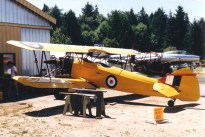
Above: A Fleet 16B Finch at the Canadian Museum of Flight.
[South Surrey, BC – 23 July 1988]
(Photo: Ahunt. Via Wikipedia.)

Above: A de Havilland Tiger Moth at Bomber Command Museum of Canada.
(Photo: John T. Stemple)
The Battle, although outmoded, had initially and relatively briefly been utilised on combat operations with RAF Bomber Command.
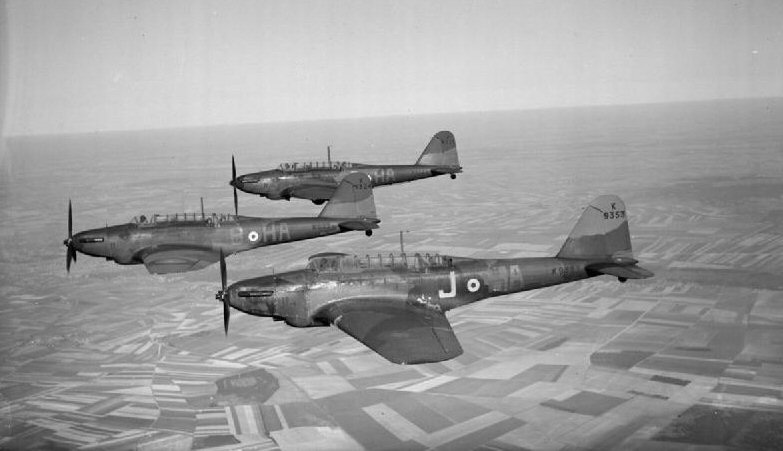
Above: Fairey Battles over France circa 1939-1940.
(RAF photograph by RAF photographer Flying Officer Stanley Arthur Devon)
[Public Domain image via Wikipedia. C449.jpg]
Battles ended their operational usage, according to Martin Middlebrook and Chris Everitt’s The Bomber Command War Diaries (page 93), on the night on 15/16 October 1940. These ‘obsolete’ aeroplanes were duly relegated to service as trainers. Notably, rare colour footage of BCATP Battles in Canada is incorporated into the 1941 film Captains of the Clouds.

Above: Ed Tracey posing with an RCAF North American ‘Harvard’ advanced trainer.
(Photo: Tim Tracey)
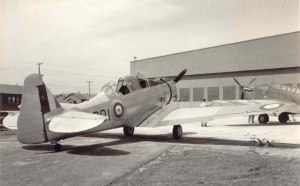
Above: Wartime photo of a North American Harvard and Fairey Battle in Canada.
(Photo: Maynard Norby / Bomber Command Museum of Canada Archives)
With the United States finally in the war and now desperately needing qualified pilots herself, Edward ‘Ed’ Tracey, an RCAF sergeant pilot at the time, transferred to the U.S. Army Air Forces (USAAF) in May of 1942. He was forthwith commissioned at the rank of ‘second-lieutenant’/’2nd lieutenant’. Tim Tracey revealed that, based on his research, ‘Approximately 3,800 men transferred from the RCAF to the USAAF. Of this group a very small number of pilots went on to become single engine combat fighter pilots and instructors during WW2.’ Ed Tracey was one of the few.
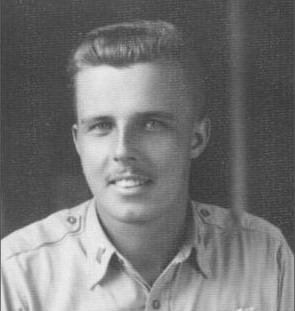
Above: 2nd Lieutenant Ed Tracey after his transfer to the USAAF.
(Photo: Tim Tracey)
Ed soon began USAAF orientation training at Tyndall Army Air Field (AAF), Florida, where he met legendary actor Clark Gable, one of the ‘A-List’ movie stars who had appeared in the classic 1939 cinematic masterpiece Gone With the Wind and other popular films, at the Tyndall ‘Officer’s Club’. ‘It was a night dad would never forget. Clark was at Tyndall to attend Gunnery School,’ said Tim Tracey. ‘When they left the club that night, dad had Gable’s “Crusher Hat” on his head and Gable was sporting my father’s headwear. I wish dad would have kept it as a souvenir, but it was returned,’ he added. ‘I would have loved to have been a part of that entire experience. It must have been awesome,’ noted Tim.

Above: Ed’s brother 2nd Lieutenant Joe Tracey.
‘Second-Pilot’ / ‘Copilot’ of a USAAF Boeing B-17 ‘Flying Fortress’.
(Photo: Tim Tracey)
Ed was stationed at Tyndall from May 1942 to May 1943 and learned to fly the following types: Curtiss-Wright AT-9 ‘Jeep’, Douglas A-33, Douglas O-46, Lockheed B-34 ‘Lexington’, Martin B-26 ‘Maurader’, North American AT-6 ‘Texan’ (designated as the ‘Harvard’ in RCAF and RAF service), North American B-25 ‘Mitchell’, North American O-47, Piper L-4 ‘Grasshopper’ and Vultee BT-13 ‘Valiant’.
Subsequently, Ed Tracey was sent to Bartow AAF, Florida, which was located very near the cities of Bartow, Winter Haven and Lakeland, from June 1943 to August 1943 for a conversion to fighters course. At Bartow AAF, he flew Curtiss P-40L ‘Warhawks’, North American P-51A ‘Mustangs’ and North American P-51B ‘Mustangs’. In total, his logbooks reflect 264 hours of training in USAAF aircraft.
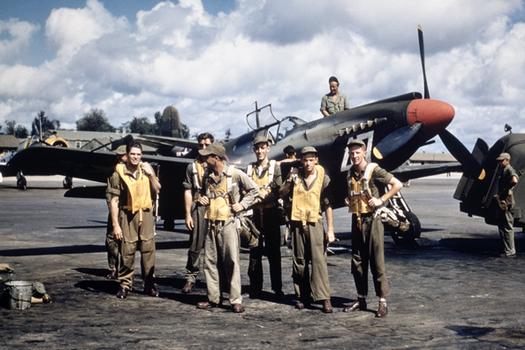
Above: USAAF pilots in Louisiana training on North American P-51A Mustangs during 1943.
(USAF photo via Wikipedia – Public Domain Image)
In September 1943 Ed found himself in the Mediterranean Theatre of Operations and specifically at Capaccio Air Base, Sicily, with the 27th Fighter-Bomber Group and flying a North American A-36 Mustang (nicknamed ‘Invader’ and ‘Apache’) dive bomber. By May 1944 his squadron had relocated to Santa Maria Airfield in Italy, where the men remained until July 1944.

Above: A graphic illustrating the aeroplane types and ‘marks’ / ‘models’ Ed Tracey piloted.
(Graphic: Tim Tracey)
While with the 27th Ed Tracey logged 165 hours (49 sorties) of combat flying in A-36s that were powered by the Allison V-1710 liquid-cooled engine with a one-stage supercharger, Curtiss P-40F Warhawks (43 sorties) equipped with Packard Motor Car Company-manufactured liquid-cooled, 12-cylinder V-1650-1 ‘Merlin’, which were manufactured under a Rolls Royce licence, aero engines with an attached single-stage, two-speed supercharger. The powerplant was capable of producing 1,033 Kilowatts (kW) or 1,385 horsepower (hp).
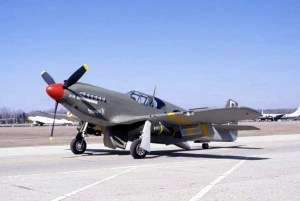
Above: Wright Patterson Air Force Base / National Museum of the United States Air Force
North American A-36A Mustang.
(Photo: U.S. Air Force)
Related to the A-36, Tim added an interesting aside: ‘I do remember my father commenting on how loud the Allison engines were. He said they were too noisy and the enemy could hear the A-36s coming. His favourite aircraft powerplants of the period were the Packard licence-built British Rolls-Royce Merlins’.
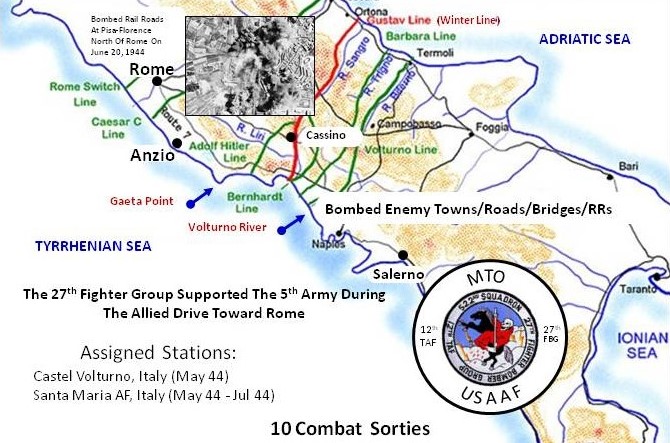
During his tenure (September 1943 to July 1944) in the campaigns around Italy, Ed Tracey completed 102 ‘operations’/combat missions as the 27th undertook attacks on Pantelleria and Lampedusa, provided air support for forces during the Allied conquest of Sicily, served as aerial cover for the landings at Salerno and worked in conjunction with the U.S. Fifth Army as it advanced toward Rome.

On one flight 2nd Lieutenant Ed Tracey’s A-36 went down. Tim Tracey described what transpired: ‘He was on a mission to take out enemy gun positions close to the front lines in south central Italy when his Apache developed engine trouble in the vicinity of Gaeta Point. As a result, my father had to leave the formation and got as far as the Volturno River valley before having to make a forced belly landing in a field. His landing was successful, but the impact caused the propeller to slice through the canopy. Thank God my dad was uninjured. His head went down and forward just in time to avoid disaster.’ Tim added, ‘He was listed as ‘Missing in Action’ but returned before a search party was deployed.’

Above: An A-36 of the 27th Fighter-Bomber Group, 522nd Fighter-Bomber Squadron.
(Photo: U.S. Air Force)
With the numbers of serviceable A-36s dwindling, Ed Tracey received a Curtiss P-40F Warhawk (designated as the ‘Kittyhawk’ in RCAF and RAF service) to fly. It’s Packard-built Merlin V-1650-1 generated 969 Kilowatts (kW) or 1,300 horsepower (hp) for takeoff and 835 kW (1,120 hp) at an altitude of 5,638 metres (18,500 feet). Maximum speed was 514 kilometres per hour (km/h)/320 miles per hour (mph) at 1524 metres (5,000 feet), 547 km/h (340 mph) at 10,000 feet, 566 km/h/352 mph at 15,000 feet and 586 km/h (364 mph) at 6,096 metres (20,000 feet). Performance then fell off appreciably at higher altitudes. Nevertheless, the type’s rugged construction and formidable armament, which consisted of six .50-calibre Browning M2 machine guns, made it an effective fighter-bomber for the Allied air forces. Notably, Warhawks and Kittyhawks were considered to be inferior to RAF and RCAF Supermarine ‘Spitfires’ but superior to Hawker ‘Hurricanes’.

Above: Hispano 20 millimetre (mm) cannon-armed RAF Hawker Hurricane Mk IIc.
(Photographed by Adrian Pingstone 7 September 2007 and placed in the public domain)
(Wikipedia image)

Above: Wright Patterson Air Force Base / National Museum of the United States Air Force
Hawker Hurricane Mk IIa.
Note the eight .303-calibre Browning machine gun ports in the wings.
(U.S. Air Force photo 050331-F-1234P-049)

Above: Ed Tracey beside his Curtiss P-40F.
(Photo: Tim Tracey)

Above: Ed Tracey and fellow pilots in front of a 522nd Squadron Curtiss P-40.
(Graphic: Tim Tracey)
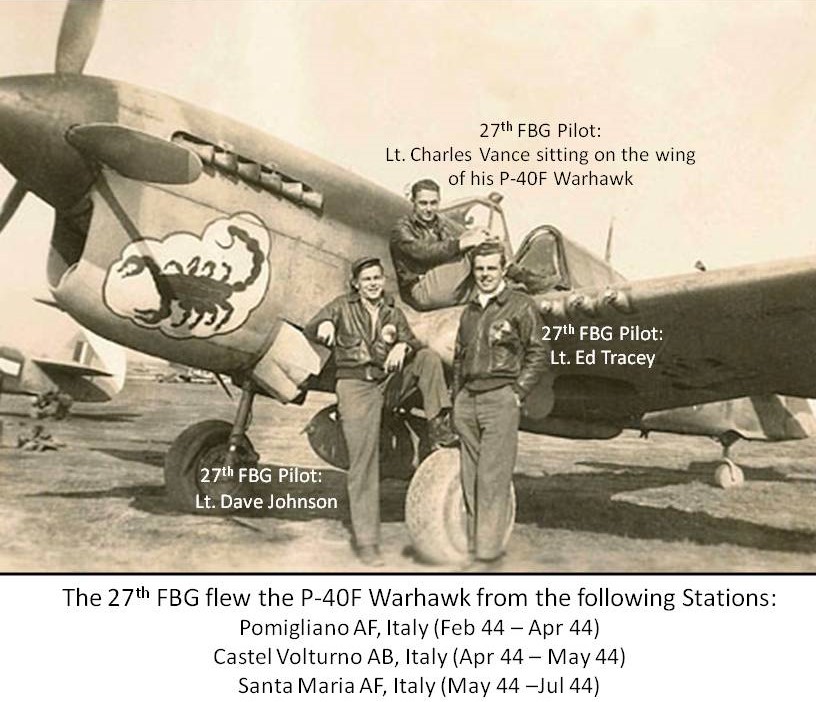
(Graphic: Tim Tracey)
Since Curtiss Warhawks & Kittyhawks were redundant (outclassed) in overall performance by 1944, Ed Tracey then moved into the cockpit of a Republic P-47D ‘Thunderbolt’ (10 sorties) fighter-bomber which featured very powerful 1,715 kW (2,300 hp) Pratt & Whitney R-2800 radial engines equipped with General Electric C-23 superchargers. This aeroplane was massive for a single-seat fighter and possessed substantially greater firepower (eight Browning M2 .50-calibre machine guns) and a top level airspeed well in excess of 643 km/h (400 mph). Thunderbolts were additionally very rugged, a quality that saved many Allied Thunderbolt pilots. For example, in 1944 a Luftwaffe (Germany’s air force) pilot once witnessed Thunderbolts attacking a railway junction in Italy and told the author the following in 1975: ‘We could see the tracer bullets from our MG-42 ‘Knochensäge’ (translates to ‘bone saw’ in English) machine guns of 7.92 millimetre-calibre, located on the train flatbed cars and nearby sand-bagged positions on the ground, ricocheting off the P-47s. Thunderbolts were like flying tanks. We were astounded.’

Above: Tim Tracey with his Republic P-47 Thunderbolt.
(Photo: Tim Tracey)
July 1944 brought a transfer to the 3rd Army Air Force at Miami Beach, Florida, where now-First Lieutenant Tracey was again detailed as an instructor. Additional teaching postings followed until December 1945. He variously taught at Harris Neck AAF (Georgia), Punta Gorda AAF (Florida), Pinellas AAF (Florida), Dyersburg AAF (Tennessee), and Esler Field (Louisiana).
Above: Graphic on Ed Tracey’s USAAF domestic service.
(Graphic: Tim Tracey)
Two additional planes Ed mastered during his 362 hours of instructional flying were the Cessna UC-78 and the vaunted P-51D ‘Mustang’ long-range escort fighter.
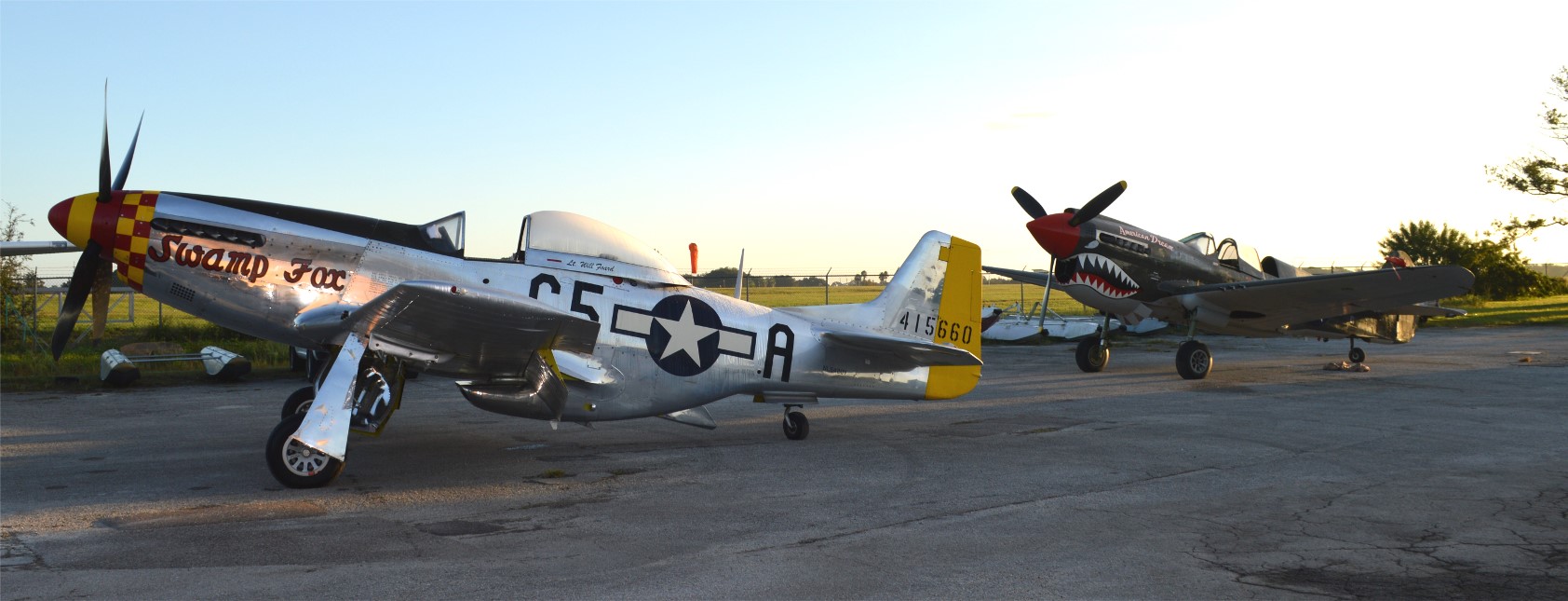
Above: North American P-51D Mustang and Curtiss TP-40 Warhawk.
[Location: Jack Brown’s Seaplane Base, Winter Haven, Florida – 14 November 2020]
(Photo: John T. Stemple)

Above: Curtiss TP-40 (trainer version of the P-40) taxying.
[Location: Jack Brown’s Seaplane Base, Winter Haven, Florida – 14 November 2020]
(Photo: John T. Stemple)

Above: Wright Patterson Air Force Base, Ohio / National Museum of the U.S. Air Force
North American P-51D Mustang and Republic P-47D (Bubble Canopy Version) Thunderbolt.
(Photo: U.S. Air Force photo by Ken LaRock)
Captain Edward Tracy was discharged from the USAAF on 7 December 1945. He had accumulated, while flying for the RCAF and USAAF, 1,200 hours from May 1941 to December 1945.

Above: A biography of Ed Tracey’s Second World War service.
(Graphic: Tim Tracey)
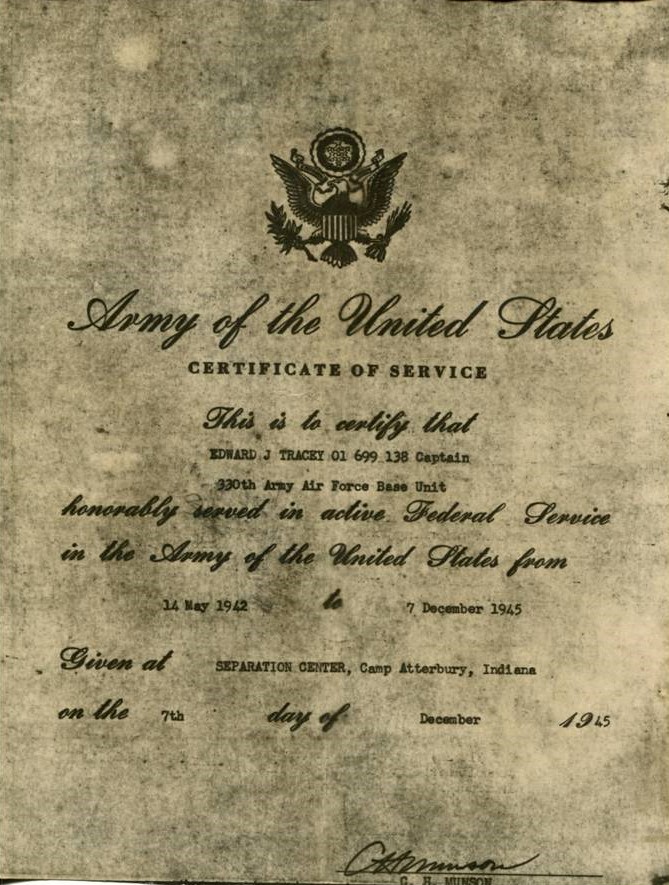
Above: Ed Tracey’s USAAF discharge certificate.
(Image: Tim Tracey)
However, Ed was hardly finished with aviation for in the 1980s he built and flew an ‘Experimental’ homebuilt category aircraft (the ‘Bushby Mustang’/’Mustang II’), a Robert Bushby design derived from David Long’s ‘Midget Mustang’.

Above: Ed Tracey in the cockpit of his Mustang II.
(Photo: Tim Tracey)
Tim Tracey is pleased that BCMC is actively recognizing the more than 8,000 Americans who joined the RCAF. The Canadian museum’s Karl Kjarsgaard has assisted with four recognition ceremonies (Virginia War Memorial, Clearwater and Winter Haven, Florida and Lakewood, Colorado) within the U.S. to date. Others are in the planning stages.
Above: RCAF tunic button on Ed Tracey’s uniform.
(Photo: Tim Tracey)

Above: Ed Tracey’s RCAF and USAAF uniform tunics.
(Photo: Tim Tracey)

Above: Grandson Jeff Tracey wearing Ed Tracey’s RCAF uniform tunic.
(Photo: Tim Tracey)
Justifiably and rightfully proud of his parent, Tim Tracey is embarking upon multiple paths that will both record and his father’s legacy and honour those of his American RCAF colleagues. Tim is also pursuing his inspirational initiative to have a Congressional medal approved and struck in the name of the RCAF-Americans and plans to publish a comprehensive book about father Ed’s flying career.

(Graphic: Tim Tracey)
The fact is that thousands of men and women enlisted at recruiting centers within the United States and Canada, and a lesser number in the United Kingdom, for direct or supportive service with Canadian and British forces. They saw the need to take action when the United States were still officially, if not always practically, neutral. In some cases the volunteers were risking their citizenship. Furthermore, scores of these individuals perished while protecting America as a result of their service in Canadian and British uniforms. According to Bomber Command Museum of Canada records, in excess of 700 are known to have perished while serving in the Royal Canadian Air Force (RCAF) alone. And yet the United States have never officially recognised these valiant Americans.
For nearly eighty years these heroes have been largely overlooked and forgotten by the governments of the United States, Canada and the United Kingdom. Thus, the rapidly dwindling number of surviving veterans would be grateful for formal remembrance. Additionally, family members have long awaited the honouring of their loved ones’ contributions to the Allied victory over Nazism and fascism.
The survivors, such as Ed Tracey, brought invaluable experience, obtained through the training received via Canadian and British service, with them upon transferring to the U.S. Military after Imperial Japan’s 7 December 1941 attack on Pearl Harbour, Territory of Hawaii.
One group, the ‘RAF Eagle Squadrons’, which consisted primarily of American aviators, did achieve acclaim and fame. The television documentary War Stories with Oliver North: Yanks in the RAF provides viewers with an excellent background relating to the RAF Eagle squadrons’ American pilot volunteers, Hollywood’s proactive encouragement and the volunteers’ neutrality and loss of citizenship concerns. Biographies of RAF-American volunteers and personal interviews are included within the film.
Americans in Royal Canadian Air Force (RCAF), Royal Air Force (RAF) and Canadian Army uniforms fought during the ‘Battle of Britain’. Three RAF fighter pilots, who are featured in the British Film Company & Elliptical Wing Limited 2018 documentary Spitfire: The Plane that Saved the World, provide timely insights on the subject of public remembrance. Ken Wilkinson says, ‘There’s not many of us left, you know. We’re not getting any younger. I doubt in five years there will be any of us.’ Tony Pickering solemnly and succinctly states the following truth: ‘We must remember those who died. We must remember that.’ In conclusion, Geoffrey Wellum adds the following paraphrased insight: ‘It’s nice [for the survivors] to be remembered because remembering covers everybody who served.’
Additionally, scores of Americans joined the Canadian Army and within the 2010 Fox News DVD War Stories Investigates: The Disaster at Dieppe it is stated, by one of the Canadian Army’s Essex Scottish Regiment veterans, that American volunteers comprised 20% of the unit.
As of the date of this posting, only two known post-war mentions of the American volunteers in Canada and Britain have been made by officials connected to the U.S. Government. The first was a reference in a speech delivered by then-General of the U.S. Army, Dwight D. Eisenhower, at the Canadian Club in Ottawa, Ontario, Canada, on 10 January 1946. According to the official text of the speech (obtained via the Dwight D. Eisenhower Presidential Library, Museum and Boyhood Home in Abilene, Kansas), the future president of the U.S. said the following: ‘During the two years when you were at war and we were not, some twelve thousand American citizens crossed your border to enter the armed forces of your country’.
The second reference was a statement placed into the Congressional Record in 2020 by Congressman Tim Ryan of Ohio (‘Saluting American Patriots of WWII for Service with the Canadian and British Armed Forces; Congressional Record of 29 September 2020, Vol. 166, No. 169 – Extension of Remarks, Page E’). This submission was requested by Tim Tracey.
For a number of years, a small group of historians and others in the U.S. and Canada have urged the U.S. Congress to pass a related Congressional Gold Medal bill. The effort began with H.R. 5887 in the 114th Congress. The subsequent piece of legislation (H.R. 1553, 115th Congress) was written with the following expanded purpose: ‘To award a Congressional Gold Medal to all United States nationals who voluntarily joined the Canadian and British armed forces and their supporting entities during World War Two, in recognition of their dedicated service’. This measure was introduced into the U.S. House of Representatives on 15 March 2017. H.R. 1553 and was composed by the author of this article according to the content parameters provided by Congressman Tim Ryan’s staff. According to the Representative’s ‘Defense Legislative Fellow’, the submitted text was accepted verbatim.
With the legislation languishing in the House, Congressman Tim Ryan sent a formal letter, the contents of which respectfully requested the issuance of a presidential proclamation, on 27 November 2017, to then-President Donald J. Trump. Surprisingly and disappointingly, no decree from the ‘Oval Office’ was forthcoming.
The legislation, under the designation of H.R. 980 (116th Congress), was reintroduced on 5 February 2019. Again, little progress in the House of Representatives was achieved.
After the commencement of the 117th Congress the proposed act (re-designated ‘H.R. 1709’, 117th Congress) was entered into a U.S. House of Representatives committee on 9 March 2021. Also, that year, the U.S. Mint agreed to produce the medals if the bill became law. As before, there was no substantial legislative movement. Therefore, a second appeal for a presidential proclamation was made on 21 June 2021, and forwarded to current President Joseph R. Biden, Jr. Yet, the occupant of the White House inexplicably declined to issue such a worthy and justifiable document.
On 3 March 2023 the basic bill text was yet again introduced, this time by Representative Abigail Spanberger, in the 118th Congress (2023-2024) as ‘H.R.1372 – American Patriots of WWII through Service with the Canadian and British Armed Forces Gold Medal Act of 2023’. Sadly, as of September 2024, the bill languishes in both the Committee on Financial Services and Committee on House Administration.
Why should Congress pass this legislation now, after nearly 80 years have passed since the end of the conflict? One must realise that the wives, sons, daughters, nieces, nephews and grandchildren of these men and women know their beloved family members served and sacrificed with the endorsement of the U.S. Commander-in-Chief. They therefore long for official recognition from the United States and the two other national governments.
Despite continuing U.S. governmental inaction, initiatives for obtaining remembrance have achieved some limited progress over the years. With a letter dated 15 June 2016, then-Speaker of the House of Commons of Canada/Chambre des Communes du Canada, The Honourable Geoff Regan, directed that a colour copy of the Book of Remembrance page related to RCAF-American James Kenneth Renaud be forwarded to this writer. The text of the correspondence included the following statement: ‘A grateful nation recognizes his sacrifice every year on September 9th, when this page is displayed for public viewing in the Memorial Chamber of the Parliament of Canada.’ Thus, many of the other Americans are likewise remembered.
Notably, former Canadian Senator Anne Kools was for many years, until her retirement in 2018, a staunch supporter of Bomber Command Museum of Canada and the organisation’s efforts to recognise the RCAF-Americans.
Furthermore, in written correspondence (dated 21 November 2019) with this author, the late Queen Elizabeth II seemed to imply that she was supportive of the principle of recognition for these valiant Americans and duly despatched a communication to Prime Minister Theresa May — who reportedly forwarded the note to the Ministry of Defence. Unfortunately, the bureaucrats at Whitehall were no more forthcoming than those within the U.S government.
Also in 2019, Canada’s Minister of Veterans Affairs provided Tim Tracey with a letter that acknowledged Ed Tracey’s RCAF service and further stated within the body of the correspondence the following: ‘Each country has duty to care for and commemorate the men and women who serve it, and I can assure you that the Government of Canada values the contributions made by foreign nationals who enlisted in our military’.

Above: The letter received from Canada’s Minister of Veterans Affairs.
(Image: Tim Tracey)
To the organisation’s credit, in May of 2022 the Commemorative Air Force dedicated an entire issue of the nonprofit’s ‘The Dispatch’ (American Eagles | May 2022 | Volume 49 | Number 3) the valiant American volunteers. Additionally, a podcast was posted on the organisation’s YouTube channel.

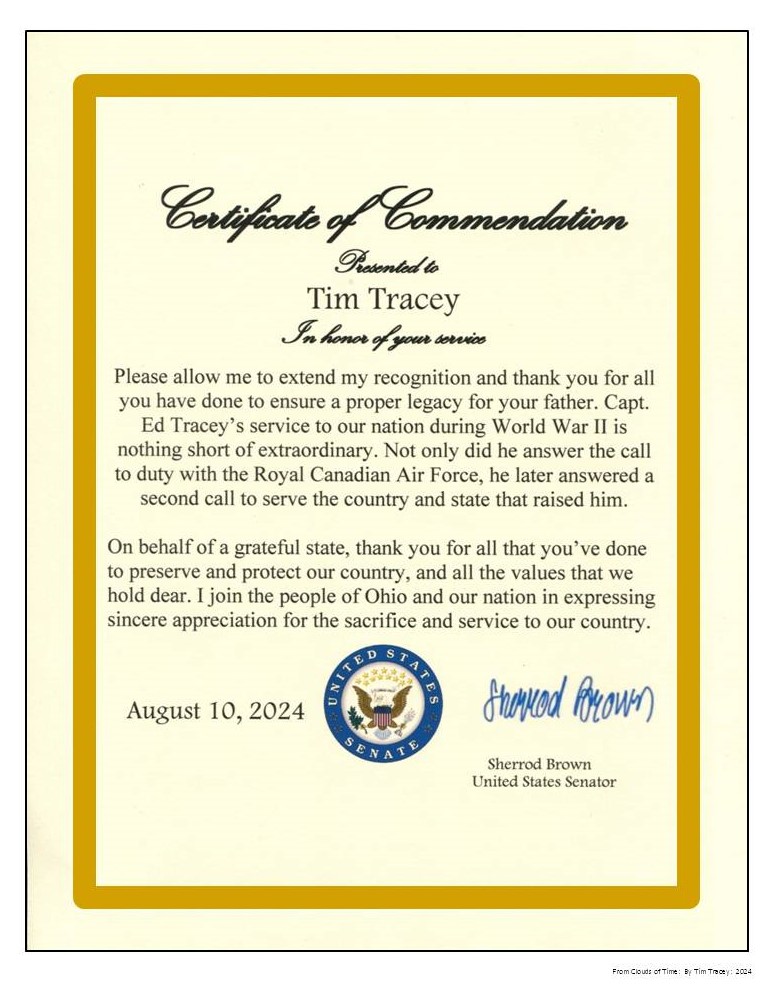
More recently, Ohio Congressman Sherrod Brown supplied a letter of commendation pertaining to Ed Tracey and his ‘service to our nation’, and in recent months he has posthumously received a few medals.

Above: A graphic describing the initiative to obtain a
‘Presidential Citizens Medals’ for the American volunteers.
(Graphic: Tim Tracey)

Above: Flyer announcing the 10 August 2024 ceremony during which an
‘American Campaign Medal’ was awarded posthumously to Ed Tracey.
(Graphic: Tim Tracey)
The title of the Canadian encyclopedic work They Shall Not Grow Old: A Book of Remembrance, which is a reference listing of deceased RCAF airmen who died between from 1939 and 1945, is an apt phrase that provides encouragement for those pursuing the worthy goal of securing the legacies of the American volunteers of the Second World War. To quote Dwight David Eisenhower, ‘For every obstacle there is a solution. Persistence is the key. The greatest mistake is giving up!’ Thus, the quest continues unabated.
________________
The author (John T. Stemple) and Tim Tracey thank Bomber Command Museum of Canada for their continuing efforts to see that the Royal Canadian Air Force-Americans of the Second World War receive adequate recognition. Furthermore, the duo salute the Royal Canadian Air Force, as this year (2024) the service branch celebrated its 100th year of existence.
Bibliography
‘218 Squadron RAF Fairey Battles over France, circa 1940’ Wikipedia (last modified 20 March 2012), https://en.wikipedia.org/wiki/Fairey_Battle#/media/File:Fairey_Battles_in_formation.jpg, accessed 16 September 2024.
’27th Fighter Group’, American Air Museum in Britain (last modified 9 July 2020), https://www.americanairmuseum.com/archive/unit/27th-fighter-group, accessed 16 September 2024.
‘A Yank in the R.A.F’, Wikipedia (last modified 5 June 2024), https://en.wikipedia.org/wiki/A_Yank_in_the_R.A.F., accessed 16 September 2024.
‘The Americans in the RCAF’, Bomber Command Museum of Canada, https://www.bombercommandmuseumarchives.ca/americansrcaf.html, accessed 16 September 2024.
‘Anne Cools’, The Canadian Encyclopedia, https://www.thecanadianencyclopedia.ca/en/article/anne-cools, accessed 16 September 2024.
Barber, Nicholas, ‘The Great Dictator: The film that dared to laugh at Hitler’, BBC (2021), https://www.bbc.com/culture/article/20210204-the-great-dictator-the-film-that-dared-to-laugh-at-hitler, accessed 16 September 2024.
Baugher, Joseph,’P-40F Warhawk, Kitttyhawk II’, Curtiss P-40 Warhawk, http://www.p40warhawk.com/Variants/P-40F.htm, accessed 16 September 2024.
‘British Commonwealth Air Training Plan’, Wikipedia (last modified 2 July 2024), https://en.wikipedia.org/wiki/British_Commonwealth_Air_Training_Plan, accessed 16 September 2024.
‘Browning .303 Mark II, Machine Gun’, The Aviation History Online Museum, http://aviation-history.com/guns/303.htm, accessed 16 September 2024.
‘Browning M2 Machine Gun’, The Aviation History Online Museum, http://aviation-history.com/guns/m2.htm, accessed 16 September 2024.
‘Canada Honors Virginia Airmen for WWII Sacrifices’, Air & Space Forces Magazine (2013), https://www.airandspaceforces.com/canada-honors-virginia-airmen-for-world-war-ii-sacrifices/, accessed 16 September 2024.
‘Captains of the Clouds’, Wikipedia (last modified 1 August 2024),https://en.wikipedia.org/wiki/Captains_of_the_Clouds, accessed 16 September 2024.
‘Cessna T-50/UC-78 Bobcat’, Warbird Alley (2016), http://warbirdalley.com/uc78.htm, accessed 16 September 2024.
Commemorative Air Force, ‘Americans in the RCAF and RAF: American Eagles’ | 2022 | Volume 49 | Number 3 Commemorative Air Force ‘The Dispatch’ March 2022, http://viewer.zmags.com/publication/e9e09c2a#/e9e09c2a/1, acessed 16 September 2024.
‘British and Commonwealth Air Training Plan’, Wikipedia (last modified 2 July 2024), https://en.wikipedia.org/wiki/British_Commonwealth_Air_Training_Plan, accessed 16 September 2024.
‘Cortland, Ohio’, Wikipedia (last modified 2 September 2024), https://en.wikipedia.org/wiki/Cortland,_Ohio, accessed 16 September 2024.
‘Curtiss P-40 Warhawk’, Wikipedia (last modified 7 September 2024), https://en.wikipedia.org/wiki/Curtiss_P-40_Warhawk, accessed 16 September 2024.
‘Curtiss P-40 Warhawk variants’, Wikipedia (last modified 1 January 2024), https://en.wikipedia.org/wiki/Curtiss_P-40_Warhawk_variants, accessed 16 September 2024.
‘Curtiss-Wright AT-9’, Wikipedia (last modified 17 September 2024), https://en.wikipedia.org/wiki/Curtiss-Wright_AT-9, accessed 17 September 2024.
‘de Havilland Tiger Moth’, Wikipedia (last modified 8 September 2024), https://en.wikipedia.org/wiki/De_Havilland_Tiger_Moth, accessed 16 September 2024.
Dickon, Chris, Americans at War in Foreign Forces: A History, 1914-1945 (1st edn, Jefferson, NC, 2014).
‘Dive Bomber (film)’, Wikipedia (last modified 1 August 2024), https://en.wikipedia.org/wiki/Dive_Bomber_(film), accessed 16 September 2024.
‘Douglas A-33’, Wikipedia, (last modified 9 September 2024), https://en.wikipedia.org/wiki/Douglas_A-33, accessed 16 September 2024.
‘Douglas O-46’, Wikipedia (last modified 17 September 2024), https://en.wikipedia.org/wiki/Douglas_O-46, accessed 17 September 2024.
‘Ernie Hall Aviation Museum’, Ernie Hall Aviation Museum, https://sites.google.com/trumbullcountyhistory.org/trumbull-history-hub/home/ernie-hall, accessed 16 September 2024.
Eyre, David C, ‘Curtiss P-40F Warhawk’, Aeromedia (last modified 19 May 2019), https://aeropedia.com.au/content/curtiss-p-40f-warhawk/, accessed 16 September 2024.
‘Fairey Battle’, Wikipedia (last modified 8 September 2024), https://en.wikipedia.org/wiki/Fairey_Battle, accessed 16 September 2024.
FDR and the Four Freedoms Speech
https://www.fdrlibrary.org/four-freedoms
‘FDR and the Four Freedoms Speech’, Franklin D. Roosevelt Library and Museum, https://www.fdrlibrary.org/four-freedoms, accessed 17 September 2024.
‘Fleet Finch’, Canadian Museum of Flight, accessed 16 September 2024.
‘Franklin D. Roosevelt’, Wikipedia (last modified ), https://en.wikipedia.org/wiki/Franklin_D._Roosevelt, accessed 17 September 2024.
Gaffen, Fred, Cross-Border Warriors: Canadians in American Forces, Americans in Canadian Forces From the Civil War to the Gulf (Toronto, 1996).
‘Home Guard (United Kingdom)’, Wikipedia (last modified 11 September 2024), https://en.wikipedia.org/wiki/Home_Guard_(United_Kingdom), accessed 16 September 2024.
‘The Honourable Lawrence MacAulay’ House of Commons/Chambre Des Communes Canada, https://www.ourcommons.ca/Members/en/lawrence-macaulay(33), accessed 16 September 2024.
‘H.R.1372 – American Patriots of WWII through Service with the Canadian and British Armed Forces Gold Medal Act of 2023’, https://www.congress.gov/bill/118th-congress/house-bill/1372/text, accessed 16 September 2024.
‘Jack Brown’s Seaplane Base’, Brown’s Seaplane Base, https://brownsseaplane.com/, accessed 16 September 2024.
Kjarsgaard, Karl,’RCAF and RAF Americans inducted into Colorado Aviation Hall of Fame’, Government of Canada/Gouvernement du Canada, https://www.canada.ca/en/department-national-defence/maple-leaf/rcaf/migration/2017/rcaf-and-raf-americans-inducted-into-colorado-aviation-hall-of-fame.html, accessed 16 September 2024.
‘Lockheed B-34 Lexington’, Wikipedia (last modified 8 September 2024), https://en.wikipedia.org/wiki/Lockheed_Ventura#Royal_Canadian_Air_Force, accessed 16 September 2024.
‘Martin B-26 Maurader’, Wikipedia (last modified 8 september 2024), https://en.wikipedia.org/wiki/Martin_B-26_Marauder, accessed 16 September 2024
‘MG-42 Machine Gun’, (2018), National WWII Museum, https://www.nationalww2museum.org/war/articles/mg-42-machine-gun, accessed 16 September 2024.
Middlebrook, Martin and Chris Everitt, The Bomber Command War Diaries. An Operational Reference Book: 1939-1945 (London: 1985).
Ministry of Defence (United Kingdom), Wikipedia (last modified 12 September 2024), https://en.wikipedia.org/wiki/Ministry_of_Defence_(United_Kingdom), accessed 16 September 2024.
‘Mustang II’, Wikipedia (last modified 4 November 2020), https://en.wikipedia.org/wiki/Mustang_Aeronautics_Mustang_II, accessed 16 September 2024.
‘Mustang Aeronautics Midget Mustang MM-1’, Wikipedia (last modified 3 December 2020), https://en.wikipedia.org/wiki/Mustang_Aeronautics_Midget_Mustang, accessed 16 September 2024.
‘Name of Canada’, Wikipedia (last modified 19 August 2024), https://en.wikipedia.org/wiki/Name_of_Canada, accessed 16 September 2024.
‘North American A-36 Apache’ Wikipedia (last modified 9 September 2024), https://en.wikipedia.org/wiki/North_American_A-36_Apache, accessed 16 September 2024.
‘North American A-36A’ National Museum of the U.S. Air Force, https://www.nationalmuseum.af.mil/Visit/Museum-Exhibits/Fact-Sheets/Display/Article/196283/north-american-a-36a-mustang/, accessed 16 September 2024.
‘North American AT-6’, Wikipedia (last modified 10 September 2024), https://en.wikipedia.org/wiki/North_American_T-6_Texan, accessed 16 September 2024.
‘North American B-25 Mitchell’, Wikipedia (last modified 10 September 2024), https://en.wikipedia.org/wiki/North_American_B-25_Mitchell, accessed 16 September 2024.
‘North American (Noorduyn) Harvard Mk IIB’, Canadian Museum of Flight, http://www.canadianflight.org/content/north-american-harvard, accessed 16 September 2024.
‘North American O-47’, Wikipedia (last modified 9 September 2024), https://en.wikipedia.org/wiki/North_American_O-47, accessed 16 September 2024.
‘North American P-51D Mustang’, National Museum of the U.S. Air Force, https://www.nationalmuseum.af.mil/Visit/Museum-Exhibits/Fact-Sheets/Display/Article/196263/USAFmuseum/north-american-p-51d-mustang/, accessed 16 September 2024.
‘Packard V-1650’, Warbirds Research Group,http://www.powerplants.warbirdsresourcegroup.org/unitedstates_powerplants_Packard_V-1650.html, accessed 16 September 2024.
‘Packard Built Version of the British ‘Merlin’ Engine Model V-1650-1 (Based on British Merlin 28)’, Combat Air Museum, https://www.combatairmuseum.org/engines/rollsroycemerlin.html, accessed 16 September 2024.
‘Packard (Rolls-Royce) Merlin V-1650-7, V-12 Engine’, National Air & Space Museum, https://airandspace.si.edu/collection-objects/packard-rolls-royce-merlin-v-1650-7-v-12-engine/nasm_A19520106000, accessed 16 September 2024.
‘Piper L-4 /O-59/L-18 Grasshopper’, Warbird Alley (2016), http://www.warbirdalley.com/l4.htm, accessed 16 September 2024.
‘Piper J-4 (Piper J-4 Cub Coupe)’, Wikipedia (last modified 11 September 2024)’, https://en.wikipedia.org/wiki/Piper_J-4, accessed 17 September 2024.
Potter, Mitch, ‘The Americans who died for Canada in WWII finally get their due: These men are my heroes’, Toronto Star (2013), http://www.thestar.com/news/world/2013/10/22/the_americans_who_died_for_canada_in_wwii.print.html, accessed 16 September 2024.
‘Pratt & Whitney R-2800’, National Museum of the U.S. Air Force, https://www.nationalmuseum.af.mil/Visit/Museum-Exhibits/Fact-Sheets/Display/Article/196237/pratt-whitney-r-2800/, accessed 16 September 2024.
‘Republic P-47D Thunderbolt’, Wikipedia (last modified 7 September 2024), https://en.wikipedia.org/wiki/Republic_P-47_Thunderbolt, accessed 16 September 2024.
‘Republic P-47D (Bubble Canopy Version)’, National Museum of the U.S. Air Force, https://www.nationalmuseum.af.mil/Visit/Museum-Exhibits/Fact-Sheets/Display/Article/196276/republic-p-47d-bubble-canopy-version/
‘Republic P-47 Thunderbolt variants’, Wikipedia (last modified 14 September 2024), https://en.wikipedia.org/wiki/Republic_P-47_Thunderbolt_variants, accessed 16 September 2024.
‘Vultee BT-13 Valiant’, Wikipedia (last modified 8 September 2024), https://en.wikipedia.org/wiki/Vultee_BT-13_Valiant, accessed 16 September 2024.
Whitehouse, Arch, The Years of the War Birds (New York, 1960).
‘Wright Brothers’, Wikipedia (last modified 29 August 2024), https://en.wikipedia.org/wiki/Wright_brothers, accessed 17 September 2024.
Suggested Viewings
 Military Aviation Chronicles
